Kalahari Red
An illustrated history, breed standard and husbandry guide for Zimbabwean breeders
Origin and history
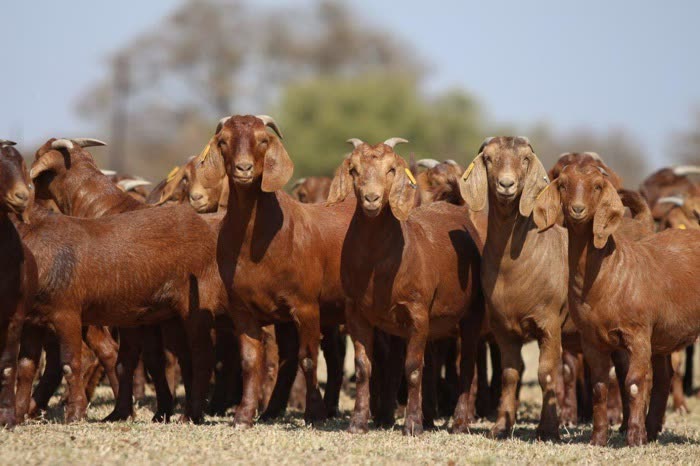
The Kalahari Red is the youngest of the three southern African meat breeds and the one with the most deliberate purpose. The Boer Goat Journal 2025 describes it as a breed built to excel in dry, difficult country like the Kalahari, assembled from goats that already carried red pigment because a dark skin and coat do not burn in a hot, sunny climate. The name refers to the red sand of the Kalahari rather than to a single place of origin.
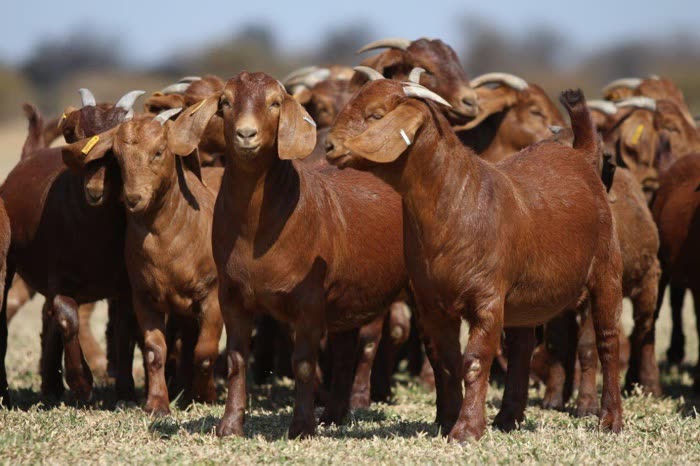
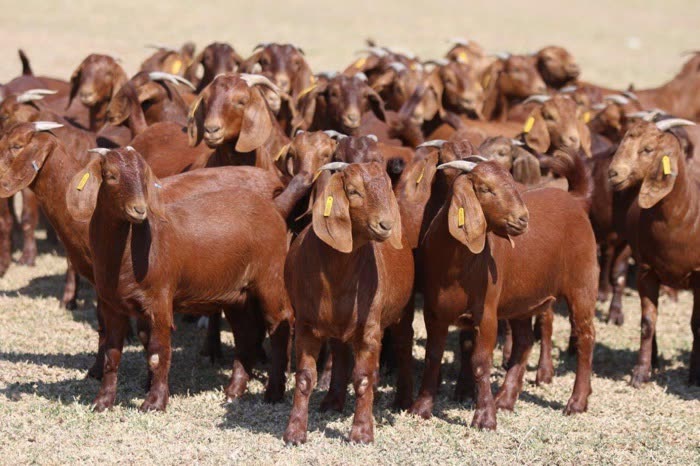
Its foundation stock were red and red-dappled lop-eared goats of the indigenous type, collected from the 1970s onwards across the northern Cape, Limpopo and Namibia by farmers who liked the way the red goats held condition, hid from predators and kept browsing in the heat. Red-pigmented Boer-type animals, which the Boer standard discriminated against, also found their way into these flocks. For two decades the red goats were bred on individual farms without a society or a written standard.
A farm-magazine article in 1996 brought the breeders together. Their animals were first shown under the name Brown Savanna in 1998, but DNA work at the Agricultural Research Council in 1998 and 1999 showed that the red goats were further from the Boer than the Boer was from the Savanna, which justified a breed of their own. The Kalahari Red Club was founded at Kimberley on 5 July 1999, the breed is usually dated to 1998, and in 2004 and 2005 the club joined the Boer Goat, Savanna and Kalahari Red societies under a collaboration agreement, so that the Kalahari Red standard was taken up alongside the Boer standard of excellence (Boer Goat Journal 2025).
Genetics went to Australia in 1999 and to the Americas soon after, and the journal notes that the breed's export trade in live animals and breeding material has grown wherever the climate is similar: Australia, Namibia, Botswana and parts of the United States. The red goat is now valued for high weaning weights, low kid mortality thanks to strong mothering, adaptation to hot arid country and lower maintenance cost than some other meat breeds. A Kalahari Red buck named Rocket set a world record for the breed when he sold for R270,000 at the Kalahari Red Club auction in Pretoria in February 2024.
Arrival and role in Zimbabwe
The Kalahari Red reached Zimbabwe later than the Boer and found its champion in Matabeleland. The late Chris Grant, a farmer in Umguza District near Bulawayo, saw Kalahari Reds on a visit to a South African farm in 2012 and was struck by their colour and condition. He started with four animals and built the Mzilikazi Kalahari Red Goats Stud, which by the early 2020s ran several hundred does, a mix of pure Kalahari Reds, Kalahari Red on Matebele crosses and Boer crosses. Through Mzilikazi Feeds and the Nkosi Breeders Club he trained smallholder farmers, sold them breeding stock, organised a breeding-goat production auction and linked farmers to markets. His death in September 2023 was reported across the farming press as the loss of the breed's pioneer in Zimbabwe; he had been a panellist at the GBAZ Indaba that year.
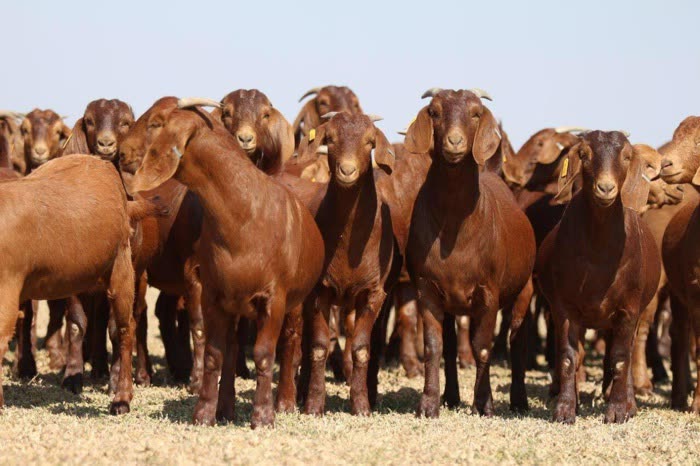
GBAZ drafted its Kalahari Red breed standard at the first Goat Indaba in 2019, alongside the Boer and Savanna standards, and the breed has been judged at the Bulawayo Agricultural Show, where Kalahari Red buck and doe classes were won by Eland Zakithi Stud in 2026. Several GBAZ member studs in Matabeleland South and Masvingo now keep registered or recorded Kalahari Reds, and the breed features in the association's auctions and the 2026 Indaba in Masvingo.
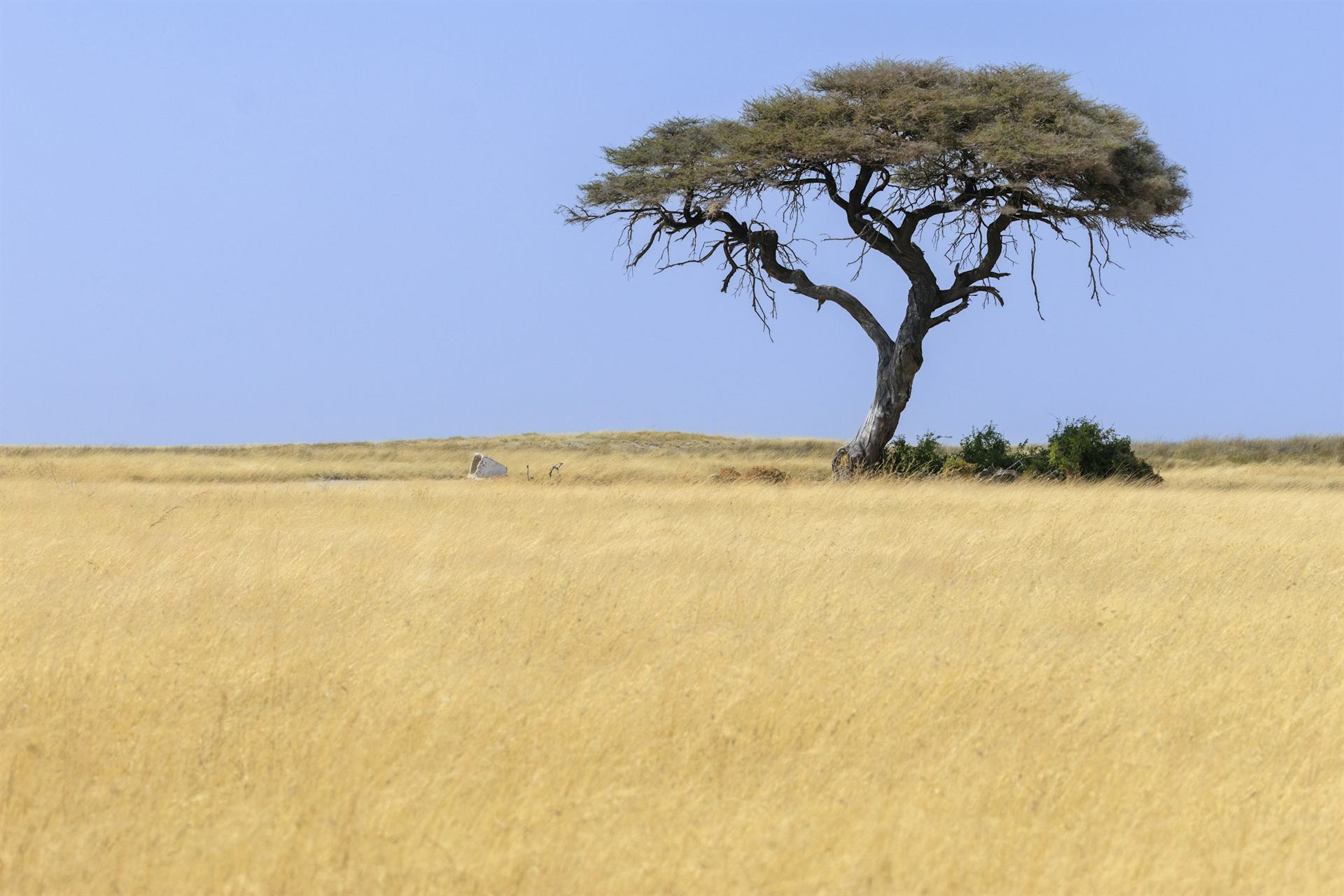
The Kalahari Red's role in Zimbabwe is defined by the map. In Natural Regions IV and V, where rainfall is unreliable, browse is thorny and the red soils of Matabeleland and Masvingo dominate, the breed's dark pigment, heat tolerance and camouflage give it an edge over the white-bodied Boer. It is the meat breed most often recommended for the drier districts, and it is the sire most commonly used on Matebele does by cooperatives such as the Queens of Reds group in Umzingwane, whose first-cross kids wean heavier than pure indigenous kids and sell at a premium. A Chronicle profile of the Mzilikazi stud quoted cross-bred females at about US$150, three-quarter-bred females at up to US$180, pure bucks at US$500 and cross-bred bucks at about US$300, a useful guide to the value that the breed adds.
The breed's limits are those of any improved meat goat: it needs more feed than an indigenous doe, routine tick and worm control, and a heartwater plan in the wetter regions. In the dry south-west these demands are modest, which is why the Kalahari Red has become the improver breed of Matabeleland.
| Year | Event |
|---|---|
| 2012 | Chris Grant sees Kalahari Reds in South Africa and starts the Mzilikazi Kalahari Red Goats Stud in Umguza with four animals |
| 2014 onwards | Mzilikazi stud grows to several hundred does; Mzilikazi Feeds trains and supplies smallholders |
| 2019 | GBAZ drafts its Kalahari Red breed standard at the first Goat Indaba |
| 2023 | Chris Grant, the breed's pioneer in Zimbabwe, dies in September |
| 2025 | Queens of Reds cooperative in Umzingwane reports first-cross Kalahari Red on Matebele kids |
| 2026 | Kalahari Red buck and doe classes judged at the Bulawayo Agricultural Show |
Breed standard
The Kalahari Red standard is the Boer Goat standard with two differences: colour, and the rule for flock goats. Everything said of the Boer's head, neck, forequarter, barrel, hindquarter, legs, skin, sexual organs and cull defects applies to the Kalahari Red. The sections below repeat the common standard for convenience and state the two breed-specific rules in full. GBAZ applies this standard at inspection, and inspected animals are registered with the Zimbabwe Herd Book.
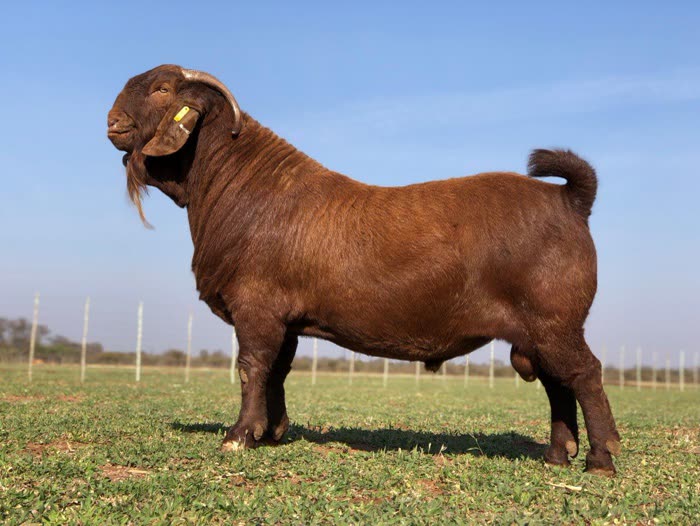
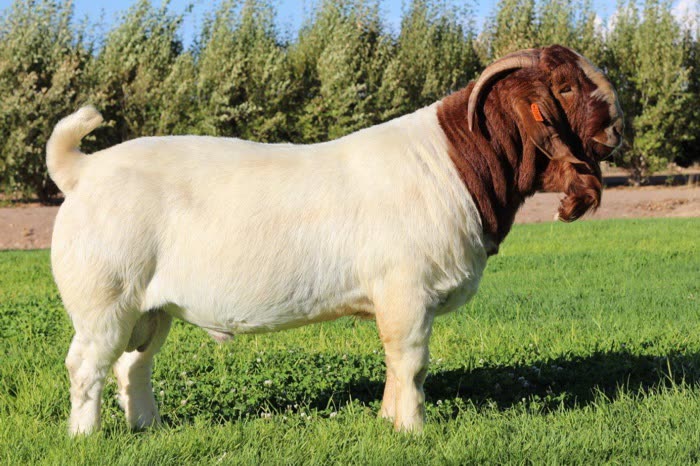
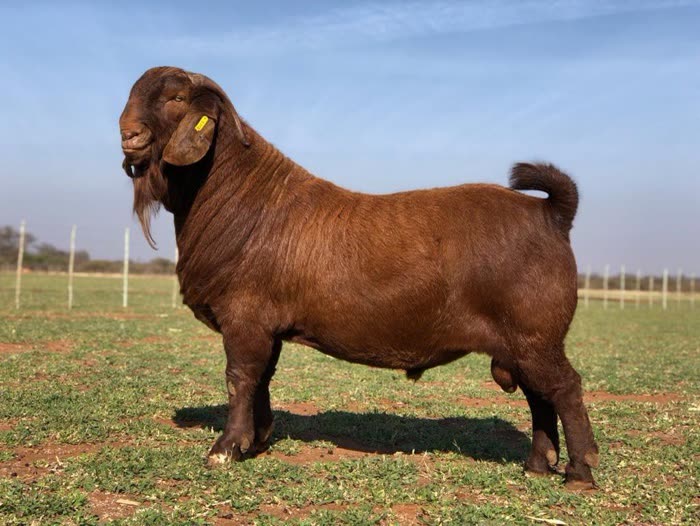
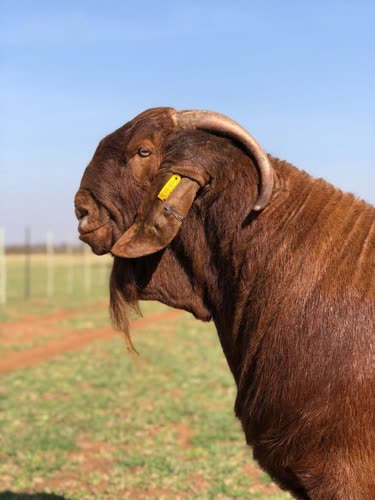
The breed's founders summarised the ideal as a medium to large goat with a long, deep body, strong legs, a fine head with soft brown eyes, a slightly Roman nose, broad pendulous ears and dark round horns curving backwards; loose supple skin with folds in the buck; a doe that wedges slightly to the front as a sign of fertility and a buck that is heavier in head, neck and forequarter.
The Kalahari Red standard is identical to the Boer Goat standard except for colour and the flock-goat rule. Summarised from the standard of excellence of the breed's founding societies, as applied by GBAZ at inspections.
- Head
- Strong, fine rather than coarse, with large soft brown eyes and a calm expression. Strong, slightly curved (Roman) nose with wide nostrils; strong, well-shaped lower jaw and interlocking jaws (up to 6 mm protrusion allowed from eight teeth). Horns strong, round, solid and dark, moderately apart and curving gradually backwards. Ears broad, smooth, of medium length and hanging. Faults: concave forehead; horns too straight, flat or pressing on the neck; over- or undershot jaw; blue eyes; ears folded, stiff or too short.
- Neck and forequarter
- Neck of moderate length, full, well fleshed and well joined. Broad breastbone, deep broad brisket; fleshy shoulders fitted to broad withers. Front legs of medium length, strong and well placed, with strong pasterns and dark hooves. Faults: neck too long and thin or too short; loose shoulders; narrow chest.
- Barrel
- Long, deep and broad; well-sprung, fleshed ribs; well-filled loin; broad, fairly straight back; not pinched behind the shoulders. Faults: concave back, slab sides, cylindrical body.
- Hindquarter
- Broad, long rump that does not slope too much; well-fleshed buttocks and thighs; tail straight at the dock. Faults: hanging or short rump; long shank; flat buttocks.
- Legs and feet
- Strong, of good texture, well placed, neither too thin nor too fleshy; strong pasterns; dark hooves. Faults: knock knees, bandy legs, cow hocks, post legs, sickle hocks, weak pasterns, hooves pointing in or out.
- Skin and coat
- Loose, supple, well-pigmented skin with folds on the neck and chest, especially in bucks; eyelids, muzzle and hairless parts pigmented; short, glossy hair. Faults: too light pigmentation; long, coarse or furry coat.
- Sexual organs
- Does: well-formed udder, firmly attached, with functional teats. Bucks: two large, well-formed, equal testes in one scrotum; split no more than 5 cm; scrotal circumference at least 25 cm. Faults: bunched, calabash or split teats; small testes; split over 5 cm; twisted scrotum.
- Colour (breed-specific)
- The ideal is a brown goat. Shadings from light to dark brown are permitted on well-pigmented skin. Occasional white hairs or small patches reappear from ancestral stock and are selected against; a motley or patched animal is not of stud class.
- Flock goat rule (breed-specific)
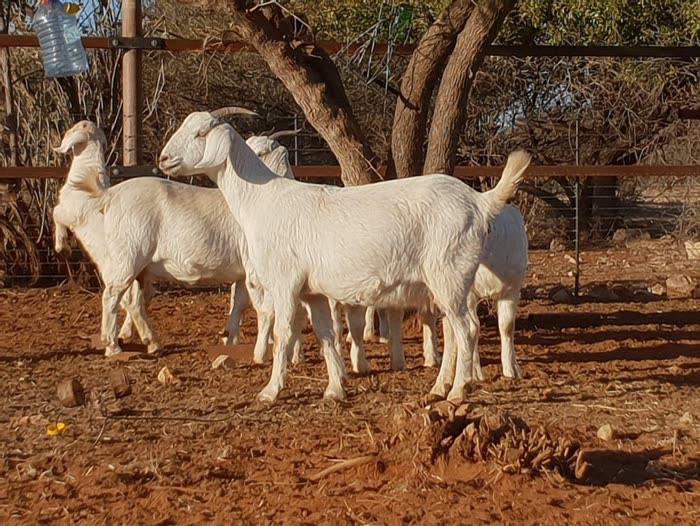
- A Kalahari Red flock (commercial) goat must be at least 75 percent brown and must not look motley. Pigment under the tail and on the hairless parts is required as for the Boer.
- Size and type
- A medium to large goat with a long, deep body on strong legs; the doe feminine and slightly wedge-shaped to the front, the buck masculine and heavier in the head, neck and forequarter. Kids longer in the leg than adults.
- Fertility rule
- Does of six teeth and older must be visibly pregnant, scanned pregnant, hold a recent pregnancy certificate or be suckling kids to be shown or auctioned; bucks of two teeth and older are fertility-tested before a national auction.
- Disqualifications
- As for the Boer Goat: concave forehead; horns too straight, flat or pressing on the neck; over- or undershot jaw; blue eyes; loose shoulders; concave back or slab sides; hanging or short rump; knock knees, bandy legs, cow hocks, post legs or sickle hocks; weak pasterns; coat too long, coarse or furry; bunched, calabash or split teats; small testes, scrotum split over 5 cm or twisted; too large or too small; too light pigmentation; and, for this breed, a coat that is less than 75 percent brown or looks motley.
Performance and production
The Kalahari Red is a large goat. The South African Journal of Animal Science morphology study gives an average wither height of about 76 cm, and the breed literature puts mature does at about 75 kg and bucks at about 115 kg under good management. Kids reach about 30 kg at six months and 100-day weaning weights of about 25 kg for bucks and 21 kg for does are quoted for stud flocks.
Birth weight depends heavily on region and management. A University of Limpopo analysis of 1,902 Kalahari Red birth records found regional averages of 2.45 kg, 3.33 kg and 3.14 kg, with season, sire, dam age, sex and litter size all significant. A Namibian study on a semi-arid farm found that breed and kidding season interacted in their effect on kid birth weight when Boer and Kalahari Red were compared. Under good feeding Kalahari Red kids are born at 3 to 4 kg, as Boer kids are.
The breed is prolific. Twins are the norm, doelings can be mated from six to seven months if they are well grown, three kiddings in two years are possible and stud flocks report kidding percentages of 150 to 200 percent. A Malaysian comparison of Savanna and Kalahari Red does under the same management recorded a conception rate of 90.6 percent, a fertility rate of 86.8 percent, a kidding rate of 125.6 percent and a prolificacy of 144.6 percent for the Kalahari Red, with pre-weaning kid mortality of 19.7 percent in a humid climate; the Savanna figures were slightly higher for reproduction and slightly lower for mortality, but the differences were not statistically significant. In the dry conditions the breed was bred for, mortality is far lower; the journal credits strong maternal instinct and robust genetics for low kid losses.
Growth is fast and the carcass is lean. A Nigerian comparison with West African Dwarf goats showed Kalahari Red kids growing several times faster to weaning, and the breed is noted for tender, low-fat meat and good skins. The does are long-lived producers, kidding and raising their young on the veld without assistance.
| Measure | Does | Bucks | Note |
|---|---|---|---|
| Mature live weight | about 75 kg | about 115 kg | Under good management |
| Height at withers | about 76 cm | about 76 cm average | Bucks taller than does |
| Birth weight | 2.5 to 3.5 kg | 2.5 to 3.5 kg | Regional averages 2.45 to 3.33 kg (1,902 records) |
| 100-day weaning weight | about 21 kg | about 25 kg | Stud flocks |
| Six-month weight | about 30 kg | about 30 kg | |
| Growth, pre-weaning | 150 to 200 g per day | 150 to 200 g per day | Depends on milk and creep feed |
| Trait | Kalahari Red | Savanna |
|---|---|---|
| Conception rate | 90.6 percent | 92.4 percent |
| Fertility rate | 86.8 percent | 89.9 percent |
| Kidding rate | 125.6 percent | 137.0 percent |
| Prolificacy | 144.6 percent | 152.3 percent |
| Pre-weaning kid mortality (humid climate) | 19.7 percent | 17.5 percent |
Adaptation and husbandry in Zimbabwean conditions
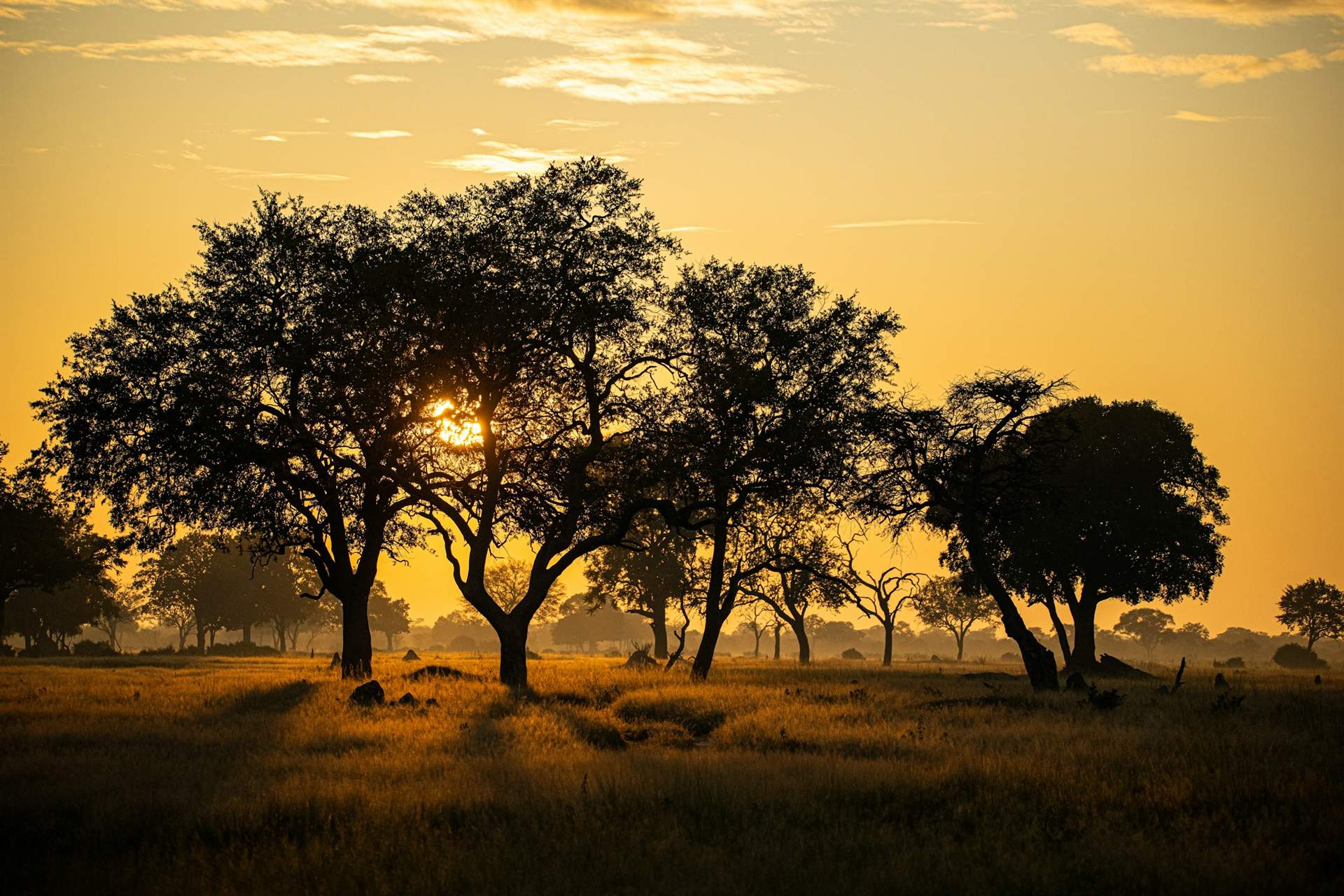
Everything about the Kalahari Red was selected for heat and drought. The deep red-brown coat and dark skin stop sunburn and skin cancer, the colour hides kids from predators in red-soil bush, the loose skin and short hair shed heat, and the breed keeps browsing through the midday heat when paler goats seek shade. The journal adds that the breed's strong, muscular build was formed by walking long distances for feed. For Matabeleland North and South, southern Masvingo, Beitbridge and the Zambezi Valley it is the improved breed that asks least of the farmer.
It still asks something. A 75 kg doe cannot rear twins on dry-season veld alone; a protein lick from June to October, access to browse rather than grazed-out grass, and creep feed for kids in stud flocks are the difference between the weaning weights in this book and the weights of an ordinary veld goat. Ticks, internal parasites and heartwater are less of a threat in the dry regions than in the north-east, but the breed is still more susceptible than the Matebele goat, so strategic dipping, FAMACHA-guided deworming and a heartwater plan where the bont tick occurs are part of the routine.
The breed's temperament helps. Kalahari Reds are calm, easy to handle and move well in a herd, which suits both commercial ranching and the smallholder kraal. Does kid unassisted and defend their kids, so the main kidding-season task is to provide a clean, dry, predator-proof area and to tag and weigh kids within a day of birth.
Mating in April and May for September and October kidding fits the rains in the south-west; where irrigated fodder is available a second mating in October is possible. Bucks should cover no more than 30 to 40 does, be checked for scrotal circumference, teeth and feet before each season, and be rested and fed between seasons. The GBAZ farm record templates provide the breeding, kidding, weight and health registers that a stud needs.
| Natural Region | Suitability | Main management points |
|---|---|---|
| IV and V (Matabeleland, southern Masvingo, Zambezi Valley) | Very good | Dry-season lick; water within walking distance; predator control at kidding |
| III (Midlands, parts of Masvingo and Mashonaland West) | Good | Tick control through the rains; strategic deworming; heartwater plan |
| II (Mashonaland, Manicaland highveld) | Fair | Higher parasite and heartwater pressure; best used as a sire on Mashona does |
Breeding and selection
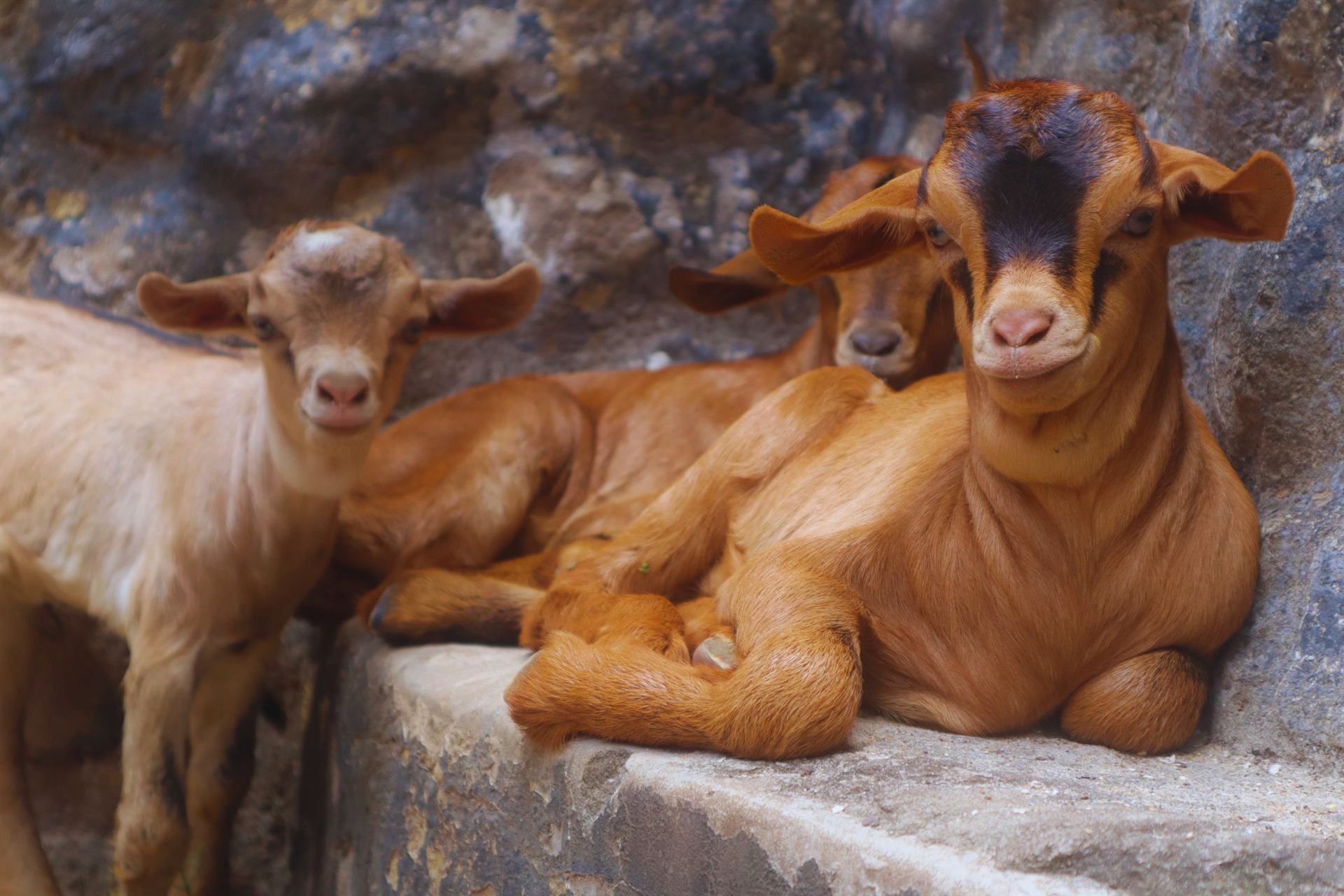
Selection in a Kalahari Red stud follows the same order as for the Boer: reproduction first, production second, conformation third. The breed's colour adds a fourth consideration. Because white patches reappear from ancestral stock, breeders select steadily for an even red-brown coat and full pigment, and the flock-goat rule, at least 75 percent brown without a motley look, separates commercial animals from stud animals. Pigment under the tail, around the eyes and on the muzzle is checked at every inspection.
Doelings are chosen from early-kidding, twin-rearing dams and from sires whose daughters wean heavy kids; bucks on their own growth, scrotal circumference, structure and dam performance. Records matter more than the eye: a doe that kids every year and weans twins at 21 kg is worth more to the stud than a bigger doe that kids every second year.
On indigenous does the Kalahari Red is the sire of choice for Matabeleland. A Kalahari Red buck on a Matebele doe produces a red or red-and-white first cross that weans heavier, grows faster and dresses out better than the pure indigenous kid, while inheriting the dam's tick and heartwater tolerance, walking ability and mothering. The cooperative experience in Umzingwane and the Mzilikazi stud's own practice both used this cross, and the cross-bred females then make useful commercial dams when mated back to a Kalahari Red or Boer buck. As with the Boer, Mashona does should be mated to younger, lighter bucks to avoid kidding difficulty, and the cross should not be graded up beyond three-quarters unless the farmer can feed and treat the animals like a stud.
Breeders who want to grade up towards registered status should keep cross records in the form the Zimbabwe Herd Book requires for foundation animals and present females for GBAZ inspection.
| Mating | Kid | Use | Caution |
|---|---|---|---|
| Kalahari Red buck x Matebele doe | First cross (50 percent) | Meat kids weaned 3 to 5 kg heavier than pure indigenous; red colour dominant | Keep dam's hardiness; do not expect stud weights |
| Kalahari Red buck x first-cross doe | Three-quarter bred | Commercial dams and heavier meat kids | Needs lick, tick and worm control like a stud |
| Kalahari Red buck x Mashona doe | First cross | Smallholder meat kids in the north and east | Use young, light bucks; watch kidding |
| Kalahari Red x Kalahari Red | Pure | Registered stud breeding, sale of bucks | Inspection and Herd Book registration |
Shows, judging and registration
Kalahari Reds are judged to the same functional standard as the Boer, with colour and pigment examined in addition. Judges handle for muscling, check the mouth for bite and age, watch the animal move and examine the udder or testes; does of six teeth and older must be pregnant, scanned pregnant or suckling to be shown or sold, and the auction rules against manipulation apply in full. In the breed's home society the Kalahari Red Club holds its own auction, where the record price of R270,000 was paid in 2024, and Kalahari Red classes are part of the national and world shows (Boer Goat Journal 2025).
In Zimbabwe, Kalahari Red buck and doe classes are judged at the Bulawayo Agricultural Show in April and at the GBAZ Goat Indaba, and the breed is offered at GBAZ auctions. The Nkosi Breeders Club auction organised by the Mzilikazi stud was the first breeding-goat auction built around the breed in Matabeleland. Judges are accredited through the South African society's courses until Zimbabwe has its own panel.
Registration follows the GBAZ path. The breeder joins as a stud breeder member and applies for a stud prefix; a GBAZ inspection classes the animals as stud, flock or cull and records the inspected stock, with a GBAZ Livestock Record Certificate for each; and the stud breeder registers the pedigree with the Zimbabwe Herd Book, the statutory registrar, which issues the registration certificate. GBAZ does not issue pedigree certificates itself.
A separate Kalahari Red society under GBAZ is expected to follow the Boer Goat Society of Zimbabwe as the number of registered breeders grows; until then the association's council and inspectors administer the standard.
| Step | Who | What happens |
|---|---|---|
| 1 | Breeder and GBAZ | Stud breeder membership; stud prefix; tags and birth notifications |
| 2 | GBAZ inspector | Animals classed stud, flock or cull against the standard; Livestock Record Certificate issued |
| 3 | Zimbabwe Herd Book | Pedigree registered; registration certificate issued by the statutory registrar |
Timeline
Key dates in the history of the breed and its establishment in Zimbabwe.
- 1970sFarmers in the northern Cape, Limpopo and Namibia begin collecting red and red-dappled lop-eared goats.
- 1996A farm-magazine article brings the red-goat breeders together.
- 1998Animals first shown as Brown Savanna; DNA testing shows the red goats are a distinct population; breed status dated to this year.
- 5 July 1999Kalahari Red Club founded at Kimberley; first genetics exported to Australia.
- 2004 to 2005Collaboration agreement with the Boer Goat and Savanna societies; the Kalahari Red standard joins the standard of excellence.
- 2012Chris Grant starts the Mzilikazi Kalahari Red Goats Stud in Umguza, Zimbabwe, with four animals.
- 2019GBAZ drafts its Kalahari Red breed standard at the first Goat Indaba.
- 2023Death of Chris Grant, the breed's pioneer in Zimbabwe.
- 2024World record price of R270,000 for the buck Rocket at the Kalahari Red Club auction, Pretoria.
- 2025First-cross Kalahari Red on Matebele kids reported by the Queens of Reds cooperative, Umzingwane.
- 2026Kalahari Red classes judged at the Bulawayo Agricultural Show; breed featured at the GBAZ Indaba in Masvingo.
Sources
This book was written from the sources below. Figures are quoted with their origin; where sources disagree the range is given. The breed's origin is stated as history; the standard applied in Zimbabwe is the GBAZ standard, and registration is by the Zimbabwe Herd Book.
- Boer Goat Journal 2025, no. 31: Kalahari Red history and characteristics, society highlights, auction records, breeding policyBoer Goat Breeders' Association journal (annual)
- Kalahari Red origin and history (by Andre Pienaar)Boer Goat Breeders' Association
- Kalahari Red breed standardsBoer Goat Breeders' Association
- Kalahari Red goat morphology (body measurements and wither height)South African Journal of Animal Science via AJOL
- Evaluation of non-genetic factors affecting birth weight of Kalahari Red goats in South AfricaUniversity of Limpopo repository
- Maturing pattern for body size, doe reproductive performance and kid mortality rate of Savanna and Red Kalahari goatsUniversiti Putra Malaysia (library record)
- Comparative study of growth patterns of Kalahari Red goats and West African Dwarf goats reared in south-west NigeriaNigerian Journal of Animal Production
- Learn about the Kalahari Red goat breedFarmer's Weekly
- Breed profile: Kalahari Red goatsGoat Journal / Countryside
- Prominent goat breeder Chris Grant dies (September 2023)The Chronicle
- Farmer builds strong genetic foundation for goat breeders (profile of the Mzilikazi Kalahari Red stud)The Chronicle
- Goat farmers urged to improve their breeds (June 2022)NewsDay
- Eland Zakithi Stud dominates Bulawayo Agricultural Show 2026 sheep and goats competition (24 April 2026)Sunday News
- Zimbabwe's goat industry evolves with new standards (9 February 2026)Farmer's Weekly
- Kalahari RedWikipedia
Register your Kalahari Red animals
GBAZ sets the breed standard and inspects animals. Stud breeder members register inspected animals with the Zimbabwe Herd Book, the statutory registrar, which issues the registration certificate.
Kalahari Red photographs
Open the photo gallery