Boer Goat
An illustrated history, breed standard and husbandry guide for Zimbabwean breeders
Origin and history
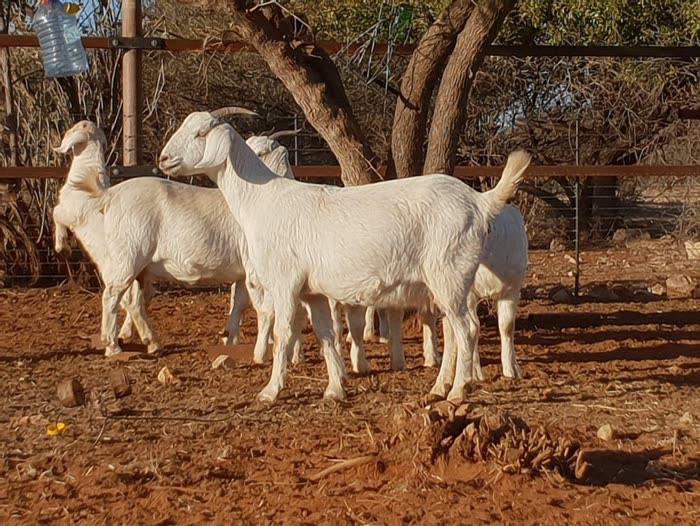
The Boer Goat is the most widely kept improved meat goat in the world, and its story begins with the ordinary lop-eared goats of southern Africa. Those goats were themselves descended from animals that had moved south with pastoral peoples over many centuries, carrying the loose skin, drooping ears and hardy constitution that still mark the breed today. Historians of the breed also point to a smaller contribution from European and Indian goats that reached the Cape through trade in the nineteenth and early twentieth centuries.
In the early 1900s farmers in the Eastern Cape, and especially around Somerset East, began to select deliberately among these goats for meat. The Boer Goat Journal 2025 records that they wanted animals with good muscling, fertility, strong mothering ability and the capacity to thrive in a harsh, semi-arid climate, and that indigenous types such as the Namaqua and San goats were crossed with imported European and Indian stock to get there. The result was a goat that grew fast, carried muscle, resisted disease and lived off thorn veld. By the 1930s a recognisable improved type existed, usually white with a red head, and farmers were already comparing animals at local shows.
The decisive step came in 1959. Encouraged by Theunis Kruger of Dirkskraal and a group of Somerset East and Middelburg farmers, a founding meeting of a breeders' association was advertised and held at Somerset East on 4 July 1959. Sixteen people attended and a committee was appointed to write breed standards and a constitution; both were approved on 16 October 1959, with T B Jordaan of Buffelsfontein as first chairman. The standard fixed the colour pattern, the strong muscular build and the calm temperament that define the breed, and organised breeding, inspection and auctions followed quickly (Boer Goat Journal 2025).
The first national sale was held at Somerset East in 1960, where 54 bucks were offered and 22 sold at an average of R135, and the first South African championships followed in 1962. From that base the breed spread through the continent and beyond. By the 1980s and 1990s breeders in the United States, Australia, New Zealand, Canada and many African countries were importing Boer genetics, and the journal notes that the breed is now exported to more than 30 countries; the FAO breed database lists it in more than 70. Through embryo and semen exports from the 1990s the Boer became the reference meat goat against which others are measured.
Today the breed society that began with sixteen farmers administers a World Show every second year, a national auction, inspection and judging courses and a quarterly newsletter, and its standard of excellence is applied, with local adaptation, by Boer goat societies across the world, including the Boer Goat Society of Zimbabwe.
Arrival and role in Zimbabwe
Boer goats have crossed the Limpopo for as long as farmers on both sides have traded stock, and Boer-type bucks have been used on indigenous does in the south of the country for decades. Formal stud breeding is more recent. Zimbabwe's goat flock, estimated at about five million head in 2025, is overwhelmingly made up of indigenous Mashona and Matebele goats kept by smallholders, and until 2018 there was no body to set a standard, inspect animals or register them.
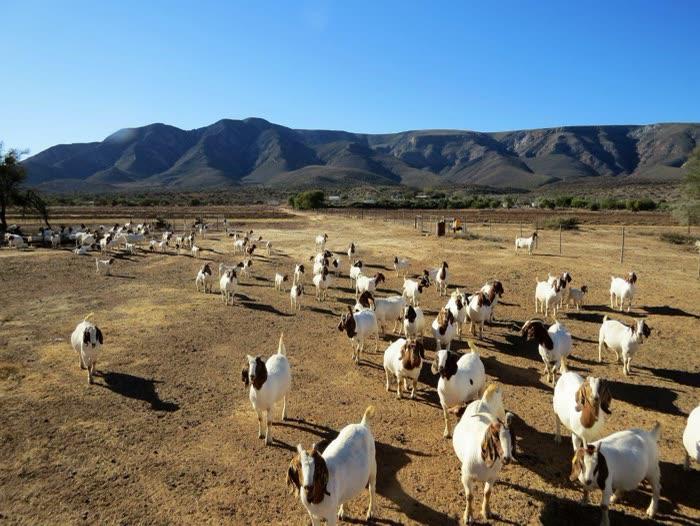
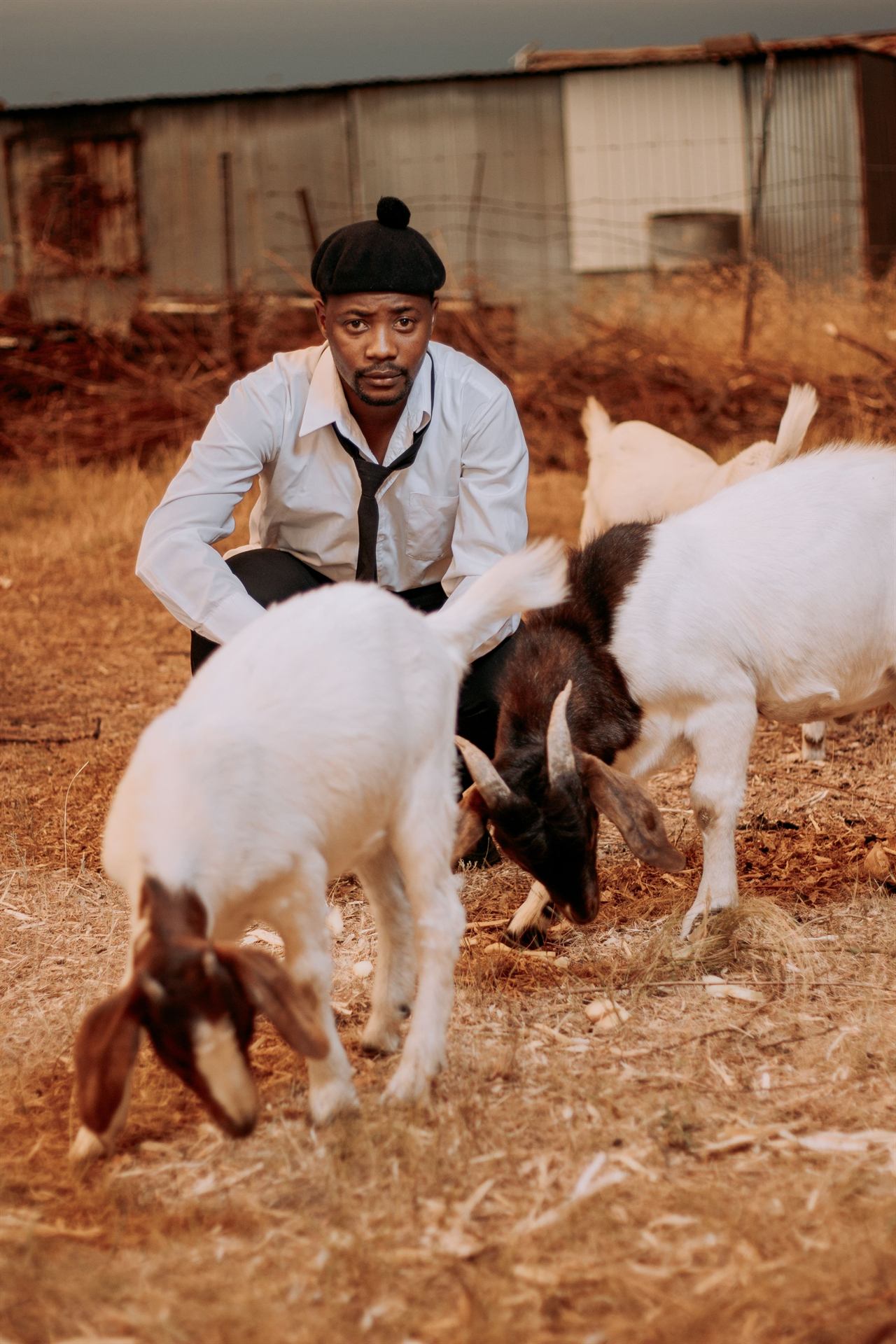
The modern chapter began when Dr Divine Simbi Ndhlukula and Anisha Cader imported stud-registered goats from South Africa and found no Zimbabwean society able to inspect or register them. After consulting the Zimbabwe Herd Book, the statutory registrar of pedigree livestock, they re-founded the Goat Breeders Association of Zimbabwe in June 2018 with three registered breeders. At the first Goat Indaba at Henderson Research Institute in 2019 the association drafted its breed standards for the Boer Goat, Kalahari Red and Savanna, drawing on the South African standards of excellence.
Breeder training followed: junior breeder courses were run with South African instructors at the 2022 and 2023 Indabas, and members have attended senior courses in South Africa. In 2025 eleven Zimbabwean breeders were formally inspected by an inspector from the South African Boer Goat Breeders' Association, making their animals eligible for registration with the Zimbabwe Herd Book. The Boer Goat Society of Zimbabwe was launched in 2025 as the first breed society under GBAZ and constituted as a GBAZ chapter in March 2026, with Xolisani Mpofu of Eland Zakithi Stud as its first executive council chairman.
The Boer's role in Zimbabwe is twofold. In stud flocks it is bred pure to the standard, inspected and registered, and sold as breeding stock: at the 2026 Bulawayo Agricultural Show top Boer bucks changed hands at more than US$2,800 each and does at about US$1,800. In commercial and smallholder flocks it is the sire breed of choice on Matebele and Mashona does, lifting weaning weight and carcass size while the indigenous dam supplies hardiness and mothering. ZimTrade's 2025 goat-meat export model, piloted in Gwanda with GBAZ, depends on exactly this kind of improved offtake.
The breed does demand more than the indigenous goat. It needs browse and supplementary feed to express its growth, routine tick and worm control, and protection from heartwater in the wetter regions. Where those are provided the Boer Goat is the most profitable meat goat in the country; where they are not, the Boer cross on an indigenous doe is the safer choice.
| Year | Event |
|---|---|
| 2018 | GBAZ re-founded in June after stud goats imported from South Africa could not be registered locally |
| 2019 | First Goat Indaba; GBAZ breed standards drafted for Boer, Kalahari Red and Savanna |
| 2022 to 2023 | Junior breeder courses with South African instructors at the Indabas |
| 2024 | First GBAZ goat auction at the Harare Showgrounds |
| 2025 | Eleven breeders inspected by a South African Boer Goat Breeders' Association inspector; Boer Goat Society of Zimbabwe launched |
| 2026 | Boer Goat Society of Zimbabwe constituted as a GBAZ chapter; Boer classes at the Bulawayo Agricultural Show |
Breed standard
The Boer Goat standard describes a functional meat animal: a goat that can walk, browse, breed every year, raise its kids and still carry enough muscle to make a profitable carcass. Inspectors and judges are told to put functional efficiency first. Movement, muscling, vitality and visible signs of fertility are rewarded; poor movement, lack of muscle, localised fat and animals that look neither feminine nor masculine are not. The extent of a phenotypic fault, not merely its presence, decides whether an animal is disqualified (Boer Goat Journal 2025).
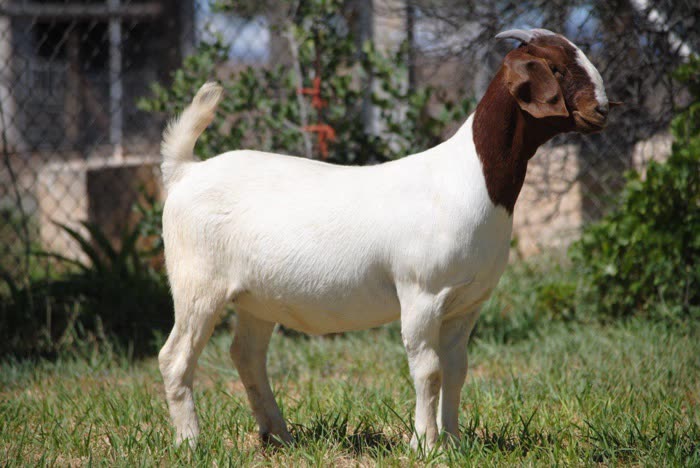
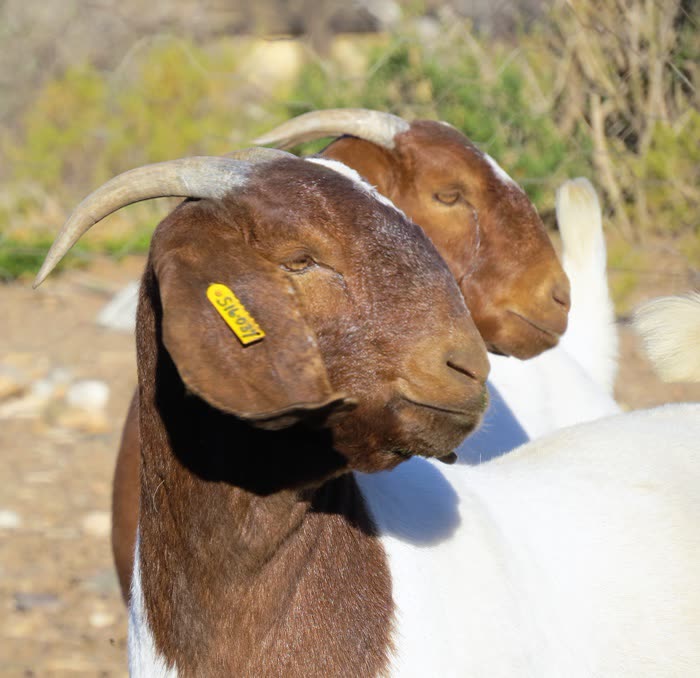
GBAZ applies the standard summarised below, which follows the standard of excellence maintained by the breed's founding society since 1959, at its inspections. The Boer Goat Society of Zimbabwe, a GBAZ chapter, is responsible for the Boer standard in Zimbabwe. Animals that pass inspection may be registered with the Zimbabwe Herd Book, the statutory registrar, which issues the registration certificate.
Summarised from the standard of excellence that the breed's founding society has maintained since 1959, as applied by GBAZ and the Boer Goat Society of Zimbabwe at inspections.
- Head
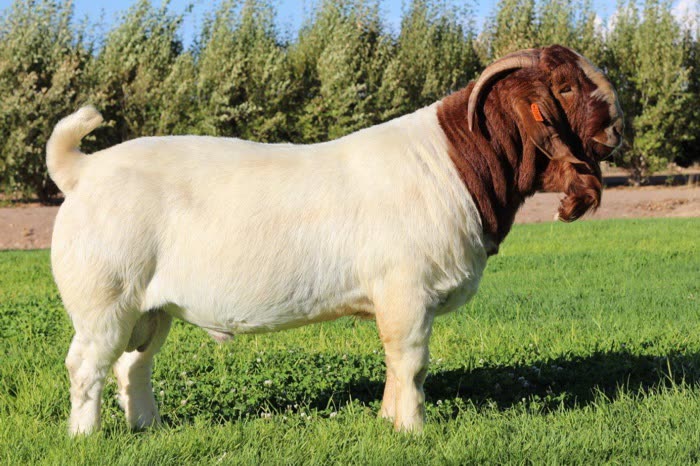
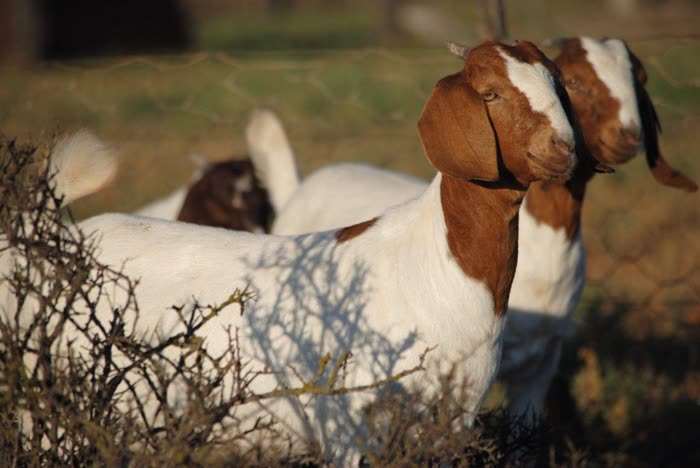
- Strong, with large soft brown eyes and a calm, not wild, expression. A strong, slightly curved nose with wide nostrils; a strong, deep, broad lower jaw with a prominent nasal bone and interlocking jaws (a protrusion of up to 6 mm is allowed from eight teeth). Forehead prominently curved, running into the nose and horn line. Horns strong, of moderate length, moderately apart, curving gradually backwards, round, solid and dark. Ears broad, smooth, of medium length and hanging. Faults: a concave forehead; horns too straight, too flat or pressing on the neck; a pointed jaw; ears folded lengthwise, stiff and protruding, or too short; over- or undershot jaw; blue eyes.
- Neck and forequarter
- Neck of moderate length in proportion to the body, full and well fleshed, well joined to the forequarter. A broad breastbone and a deep, broad brisket. Fleshy shoulders fitted firmly to broad withers. Front legs of medium length, strong and well placed, with strong pasterns and dark, well-formed hooves. Faults: a neck too long and thin or too short; loose shoulders; a pinched or narrow chest.
- Barrel
- Long, deep and broad, with well-sprung, fleshed ribs, a well-filled loin and a broad, fairly straight back. The animal must not be pinched behind the shoulders. Faults: a concave back, slab sides, a cylindrical body or a body pinched behind the shoulder.
- Hindquarter
- A broad, long rump that does not slope too much, with well-fleshed buttocks and thighs and a tail set straight at the dock. Faults: a rump that hangs or is too short; a long shank; flat buttocks.
- Legs and feet
- Legs strong, of good texture and well placed, neither too thin nor too fleshy, with strong pasterns and dark hooves. Faults: knock knees, bandy legs, cow hocks, post legs, sickle hocks, weak pasterns, hooves pointing in or out.
- Skin and coat
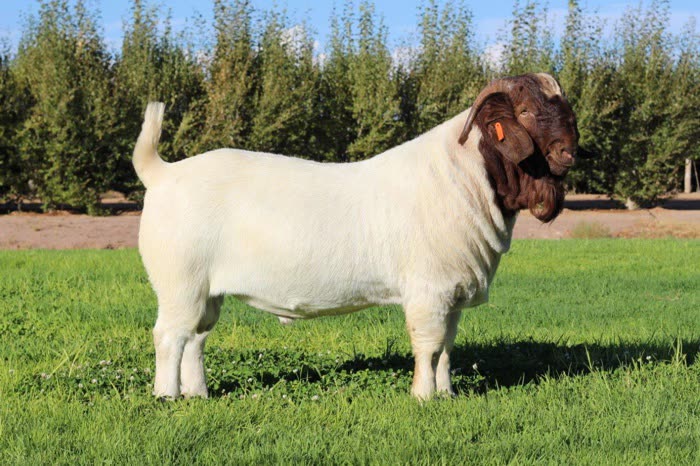
- Loose, supple skin with folds on the neck and chest, especially in bucks. Eyelids and hairless parts pigmented; at least 75 percent pigment under the tail for stud animals, with 100 percent ideal. Short, glossy hair; a limited amount of winter fur is tolerated. Faults: too light pigmentation; a coat that is too long, coarse or furry.
- Sexual organs
- Does: a well-formed udder firmly attached, with functional teats; teat types classed as flock rather than cull are excluded from shows and national auctions. Bucks: two large, well-formed, equal testes in one scrotum, with a split of no more than 5 cm and a scrotal circumference of at least 25 cm. Faults: bunched, calabash or split teats; small testes; a scrotum split of more than 5 cm; a twisted scrotum.
- Colour
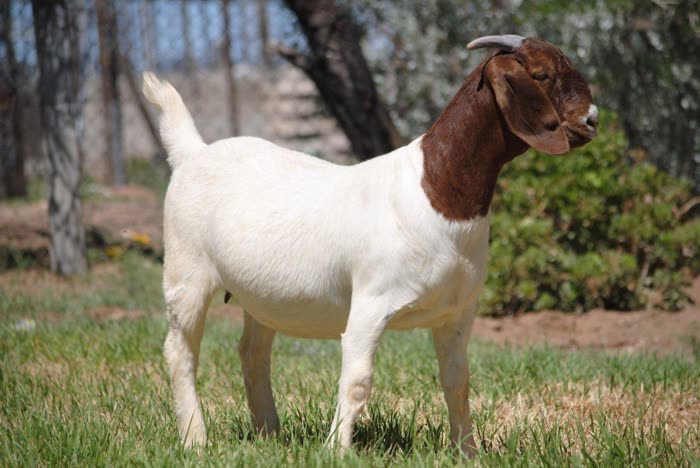
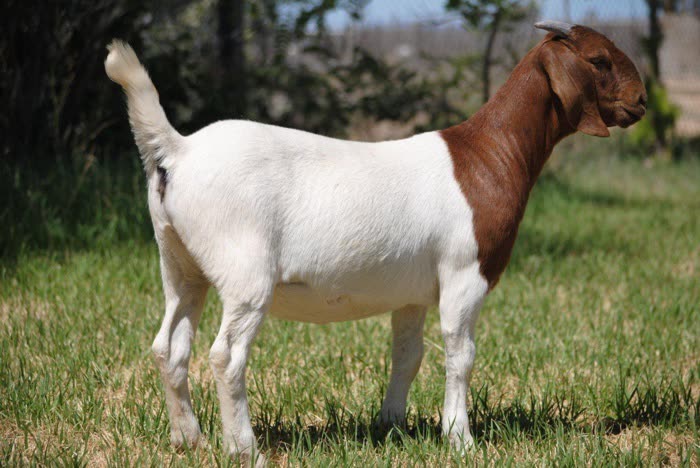
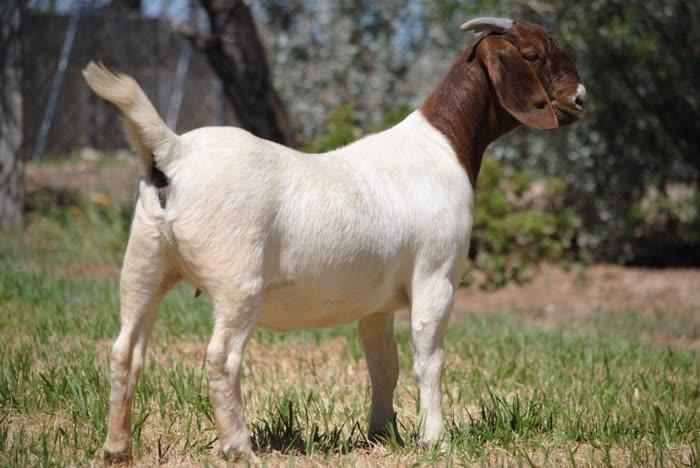
- The ideal is a white body with a red head and ears and a white blaze, on fully pigmented skin, with red shading from light to dark permitted. Stud animals need a red patch of at least 10 cm on both sides of the head and at least 75 percent red on the ears; only one body patch of up to 10 cm is allowed on the barrel, hindquarter and underline; leg patches of 5 cm combined; the tail may be red but not more than 2.5 cm onto the body. A flock (commercial) goat may be up to 50 percent red provided it does not look motley and has at least 25 percent pigment under the tail.
- Size and type
- An average-sized, heavy goat with a correct ratio of leg length to body depth; kids are longer in the leg than adults. The doe is feminine and wedges slightly to the front, a sign of fertility; the buck is masculine, heavier in head, neck and forequarter. Faults: too large or too small (pony type).
- Fertility rule
- To be shown or offered at a protected auction, does of six teeth and older must be visibly pregnant, scanned pregnant, hold a pregnancy certificate less than a month old, or be suckling kids present on site. Bucks of two teeth and older must pass a veterinary fertility test before a national auction.
- Disqualifications
- Concave forehead; horns too straight, too flat or pressing on the neck; over- or undershot jaw; blue eyes; loose shoulders; concave back, slab sides or a cylindrical body; a rump that hangs or is too short; knock knees, bandy legs, cow hocks, post legs or sickle hocks; weak pasterns; hooves pointing in or out; a coat too long, coarse or furry; bunched, calabash or split teats; small testes, a scrotum split over 5 cm or a twisted scrotum; too large or too small; too light pigmentation. Other registries also disqualify a wry face and cleft palate.
Performance and production
Published figures for the Boer Goat vary with country, nutrition and management, and performance outside its home flocks is usually below the stud figures quoted here. The tables give the ranges reported by the FAO breed description of 1991, the breed society literature and field studies, so that Zimbabwean breeders can judge their own animals against a realistic benchmark rather than an advertisement.
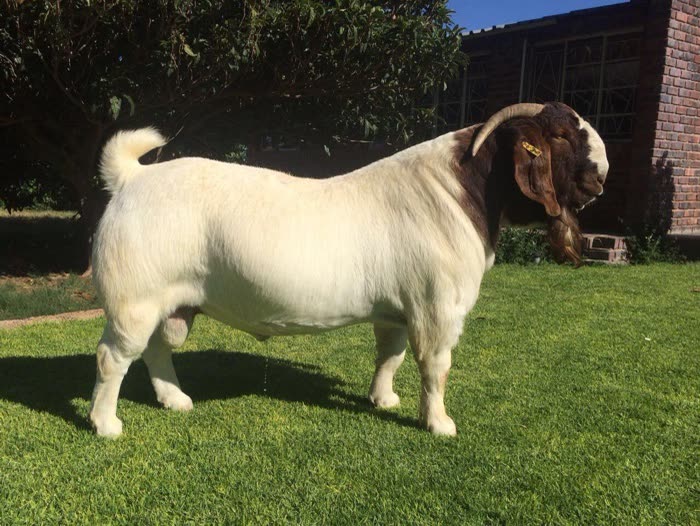
Mature Boer does weigh 70 to 100 kg and bucks 110 to 140 kg under good management, standing roughly 75 to 80 cm at the withers for does and 90 cm or more for bucks. Kids are born at 3 to 5 kg, with singles heavier than twins and triplets. On extensive sub-tropical veld growth of about 175 g per day is reported, and more than 200 g per day under intensive feeding, so that stud kids reach 25 to 33 kg at 100 days. Selection in South African flocks raised the 100-day weight of male kids from 24 to 32 kg and of female kids from 22 to 28 kg between 1970 and 1982, which shows how much is gained by recording and culling.
The doe is polyoestrous and can be bred all year, with a peak of activity in autumn. Gestation is about 148 days. Litter size in recorded flocks is about 1.64, with roughly 43 percent single, 50 percent twin and 7 percent triplet births; three kiddings in two years are possible and kidding rates of 150 to 200 percent are widely reported from stud flocks. Boer does milk 1.5 to 2.5 kg per day at about 7.7 percent fat, and it is this milk that drives weaning weight. A Namibian farm study of 1,271 kid records found an average birth weight of 4.1 kg, a weaning weight of 19.6 kg and pre-weaning gain of 151 g per day under ordinary commercial conditions, a useful reminder that the stud figures are a ceiling rather than a floor.
Carcass quality is the breed's strongest card: dressing percentages of 48 to 54 percent, a high proportion of saleable meat and low fat are the reasons the journal calls carcass quality outstanding and the reasons abattoirs pay a premium for Boer and Boer-cross kids.
| Measure | Does | Bucks | Note |
|---|---|---|---|
| Mature live weight | 70 to 100 kg | 110 to 140 kg | FAO gives 70 to 90 kg and 120 to 140 kg |
| Height at withers | 75 to 80 cm | 90 cm and more | Survey average 78 cm and 94 cm |
| Birth weight | 3.0 to 5.0 kg | 3.0 to 5.0 kg | Singles 4.5 kg, twins 3.9 kg, triplets 3.5 kg |
| 100-day weight (stud) | 22 to 28 kg | 24 to 33 kg | Improved flocks, 1970 to 1982 trend |
| Growth, extensive veld | about 175 g per day | about 175 g per day | Kids to weaning |
| Growth, intensive | over 200 g per day | over 200 g per day | Feedlot or creep fed |
| Milk yield | 1.5 to 2.5 kg per day | About 7.7 percent fat |
| Trait | Value |
|---|---|
| Breeding season | All year, peak in autumn |
| Gestation | About 148 days |
| Age at first kidding | About 12 months when well grown |
| Kidding interval | About 12 months; three kiddings in two years possible |
| Litter size | 1.64 (43 percent single, 50 percent twin, 7 percent triplet) |
| Kidding rate, stud flocks | 150 to 200 percent |
| Artificial insemination | 71 percent of does pregnant, 1.9 kids per birth |
Adaptation and husbandry in Zimbabwean conditions
The Boer Goat was made for semi-arid thorn veld, and in Natural Regions III to V of Zimbabwe it is at home. Its pigmented skin resists sunburn and skin cancer, the loose supple skin and short hair shed heat, and its wide mouth and strong jaws let it strip browse that cattle cannot use. The breed's standard explains the white body as a practical choice too: a white goat is easy to see and round up in dense bush, while the red head keeps the pigment where the sun strikes hardest.
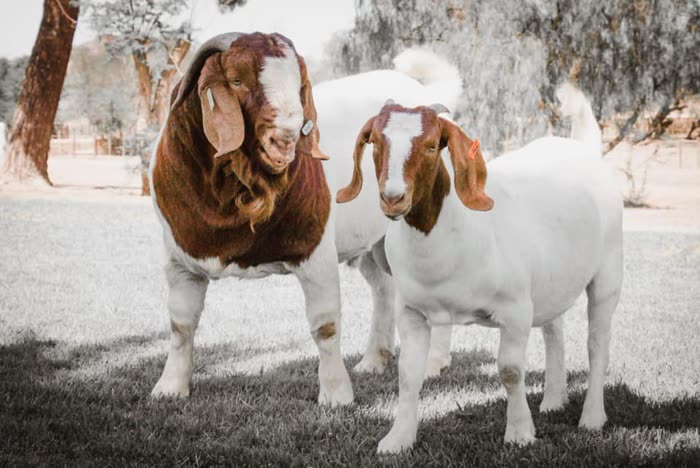
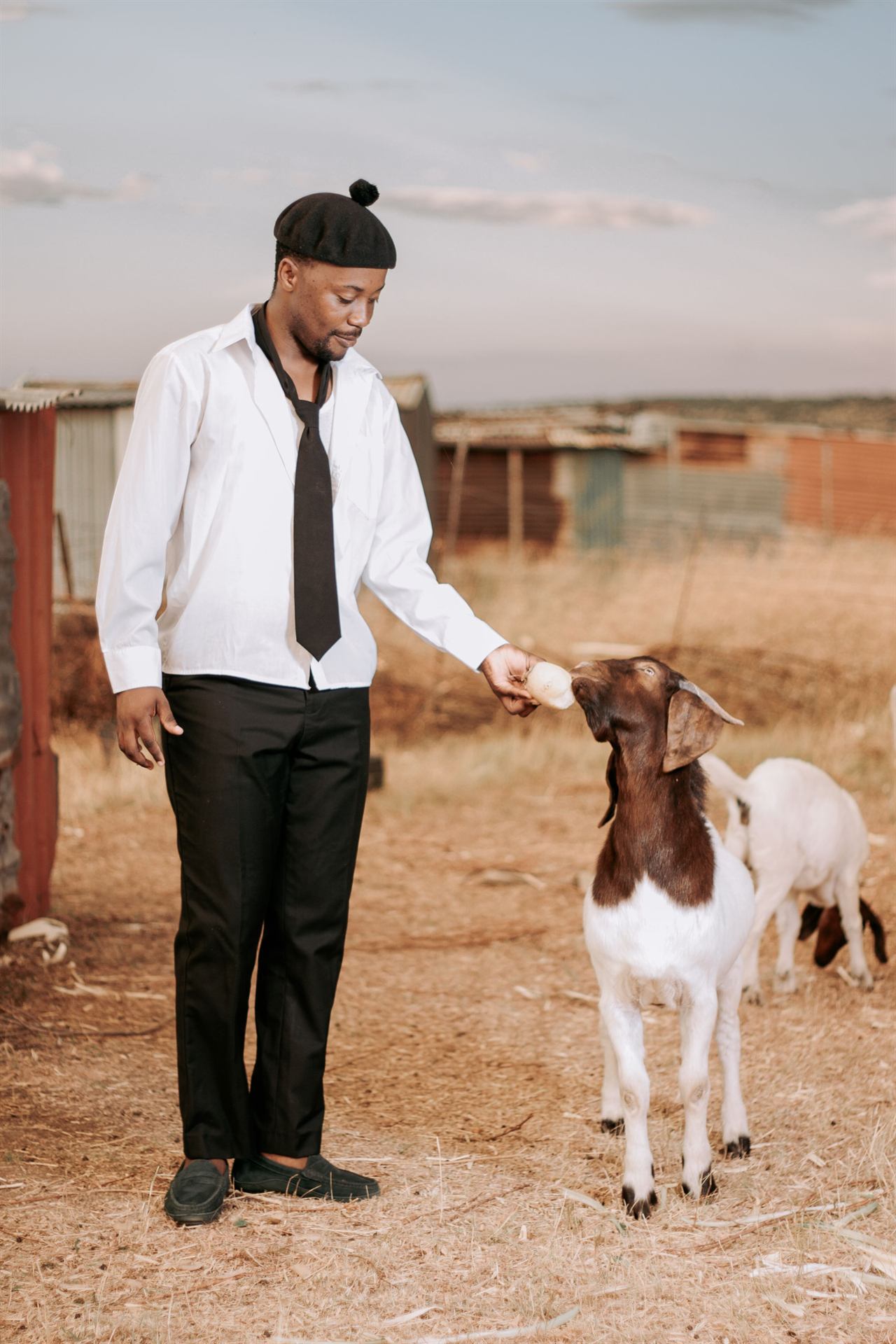
Three things limit the Boer in Zimbabwe. The first is nutrition: a 100 kg doe needs more feed than a 35 kg indigenous doe, and without browse, a dry-season protein lick and, in stud flocks, a measure of concentrate, Boer kids will not reach the weights quoted in this book. The second is disease. Boer goats are more susceptible than indigenous goats to heartwater, to internal parasites and to tick-borne infection in the wetter north and east, so routine dipping or pour-on treatment, strategic deworming guided by FAMACHA scoring and a heartwater plan are essential. The third is the kid itself: with twins common and kids born at 4 kg, does need a clean kidding pen, colostrum within the first hours and protection from cold and predators.
A practical year for a Zimbabwean Boer flock runs with the rains. Mating in April and May gives kidding in September and October, when browse is flushing and the worst of the cold is over, and weaning at about 100 days in January. A second mating of early-kidding does in October is possible under good feeding but should not be forced in Natural Region V. Bucks should be put to no more than 30 to 40 does and checked for scrotal circumference, teeth and feet before each season. Hoof trimming twice a year, a clostridial vaccination programme, and clean water within walking distance of the browse complete the routine.
Housing need not be elaborate. A dry, well-ventilated kraal with a roofed section for kidding, raised slatted sleeping areas where termites and mud are a problem, and a crush for inspection and treatment will serve a stud flock. Records are the other half of husbandry: tag every kid at birth, record dam, sire, birth type, birth weight and 100-day weight, and cull does that fail to kid in two consecutive seasons. The GBAZ farm record templates on this website are designed for exactly this.
| Month | Flock task | Health task |
|---|---|---|
| March | Condition-score does; cull non-breeders | Clostridial booster; trim feet |
| April to May | Mating, 1 buck to 30 to 40 does; flush does on green browse or lick | Buck fertility check; dip or pour-on against ticks |
| June to August | Dry-season protein lick; separate pregnant does | FAMACHA check monthly; deworm only animals that need it |
| September to October | Kidding in clean pens; colostrum within 6 hours; tag and weigh kids | Navel treatment; watch for heartwater in wet areas |
| November to December | Creep feed kids; record growth | Tick control as rains begin; coccidiosis watch in kids |
| January | Wean at about 100 days; weigh and record | Deworm weaners strategically; vaccinate |
| February | Select replacement doelings and bucks for inspection | Trim feet; treat for external parasites |
Breeding and selection
The founding society's breeding policy puts reproduction first, production second and conformation third, and that order is a good guide for Zimbabwean breeders. Reproduction means a net reproduction rate above one, a kidding interval under a year, fertile bucks and does that milk well and mother their kids. Production means weaning weight and post-weaning growth measured on the veld, not only in a feedlot; the journal warns that selecting breeding animals under feedlot conditions alone hides the hardiness that the breed must keep. Conformation, the standard of excellence, comes third because a beautiful goat that kids every other year is a loss.
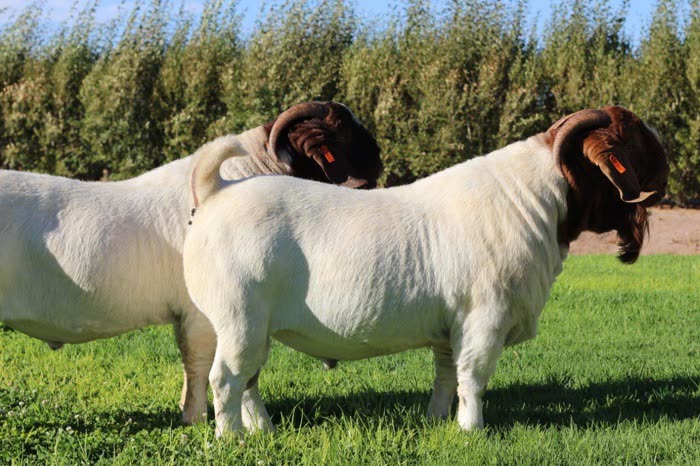
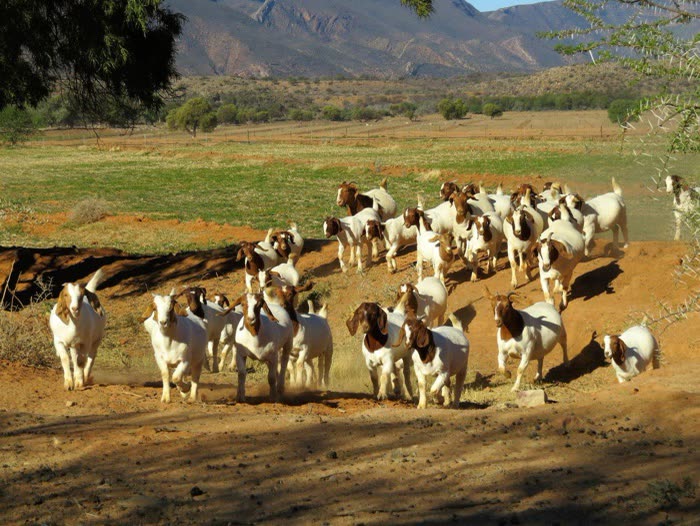
In a pure stud flock, selection starts with the record book. Doelings are chosen from does that kid early in the season, raise twins and wean heavy kids, and from sires whose daughters do the same. Bucks are selected on their own 100-day and 12-month weights, scrotal circumference, structural correctness and the performance of their dams. Inspection then classes each animal as stud, flock or cull against the standard, and only stud-class animals are registered. Line breeding within a stud is acceptable when it is deliberate and recorded; mating close relatives by accident is not, which is one reason the Zimbabwe Herd Book insists on sire and dam identification.
For the commercial and smallholder flock the Boer's greatest contribution is as a terminal or improver sire on indigenous does. A Boer buck on a Matebele or Mashona doe produces a first cross that weans heavier and dresses out better than the pure indigenous kid, while the dam contributes tick and heartwater tolerance, mothering and the ability to walk far for browse. Research on crossbreeding in Binga and the experience of cooperatives in Matabeleland South both point the same way. Two cautions apply: Mashona does are small and should be mated to younger, lighter Boer bucks to avoid kidding difficulty, and the first cross should be the end product for meat; backcrossing to Boer again increases the kid's need for feed and health care with each generation.
Breeders who want to grade up a flock towards registered Boer status should keep the cross records that the Herd Book requires for foundation animals and present the females for inspection. GBAZ can advise on the grading rules that apply.
| Priority | Trait group | What to measure |
|---|---|---|
| 1 | Reproduction | Kids weaned per doe per year; kidding interval; buck fertility; milk and mothering |
| 2 | Production | 100-day weaning weight; post-weaning gain on veld; hardiness and adaptability |
| 3 | Conformation | Breed standard: functional efficiency, muscling, movement; degree of fault decides disqualification |
| 4 | Recording | Tag, parentage, birth type and weights recorded; inspected animals registered with the Zimbabwe Herd Book |
Shows, judging and registration
Shows and auctions have been part of the Boer Goat since 1960, and the rules that grew up around them are designed to protect the buyer. In the founding society's system a World Show is held every second year and a national show in the alternate year; regional championships are open to club members; and no animal under ten months old or lighter than 40 kg may be offered at a protected auction. Does of six teeth and older must be visibly pregnant, scanned pregnant or suckling kids to be shown or sold, and bucks of two teeth and older must pass a veterinary fertility test before a national auction. Any manipulation of an animal, from pressing jaws to colouring pigment or pulling red hairs, is grounds for suspension. These are the conventions that GBAZ and the Boer Goat Society of Zimbabwe adopt for their own events (Boer Goat Journal 2025).
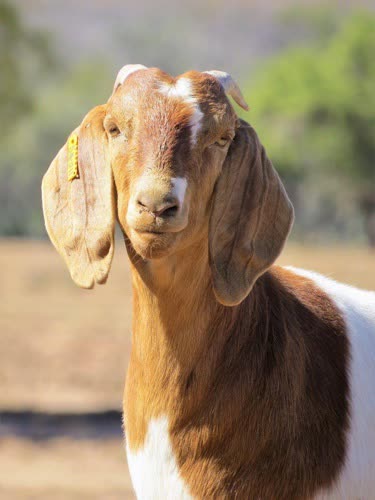
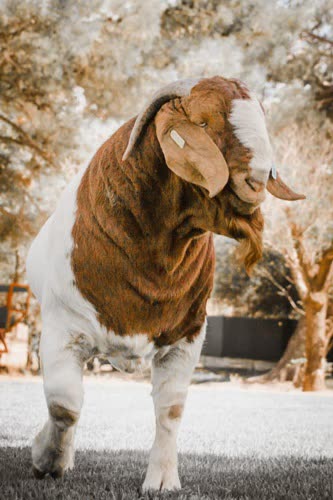
In Zimbabwe the show season runs from the Bulawayo Agricultural Show in April, which in 2026 judged Boer buck and doe classes alongside Kalahari Red, Savanna, Saanen and indigenous goat classes, through the provincial shows to the Harare Agricultural Show and the GBAZ Goat Indaba in October or November, where the association's auction is held. GBAZ's first auction took place at the Harare Showgrounds in 2024. Judging follows the breed standard: animals are handled for muscling, mouths are checked for bite and age, legs and feet are examined on the move, and the sexual organs are inspected. Judges' courses with the South African society are the route to accreditation while Zimbabwe builds its own panel.
Registration is a three-step process. First the breeder joins GBAZ as a stud breeder member and applies for a stud prefix. Second, a GBAZ inspection classes the animals against the standard and records the inspected stock in the GBAZ register; the association issues a Livestock Record Certificate for each recorded animal. Third, the stud breeder applies to the Zimbabwe Herd Book, the statutory registrar under the Registration of Pedigree Farm Livestock Act, which registers the pedigree and issues the registration certificate. GBAZ sets the standard and inspects; the Herd Book registers. The two roles are separate and the association does not issue pedigree certificates itself.
Animals recorded by GBAZ carry an ear tag with the stud number and the animal number, and parentage is recorded at birth notification. Buyers of registered stock should ask for the Herd Book certificate and the GBAZ inspection class, and can verify any GBAZ certificate serial on this website.
| Rule | Requirement |
|---|---|
| Minimum age and weight at auction | 10 months and 40 kg |
| Does, 6-tooth and older | Visibly pregnant, scanned pregnant, holding a recent pregnancy certificate, or suckling kids present on site |
| Bucks, 2-tooth and older, national auction | Veterinary fertility test at the venue |
| Inspection before sale | All animals inspected; mouths may be re-checked the day before |
| Manipulation | Pressing jaws, colouring pigment, pulling red hairs, cutting teats: exhibitor may be suspended |
| Entries | No entries after the show society's closing date; only entered animals sold at the show auction |
| Step | Who | What happens |
|---|---|---|
| 1 | Breeder and GBAZ | Stud breeder membership; stud prefix; tags and birth notifications |
| 2 | GBAZ inspector | Animals classed stud, flock or cull against the standard; GBAZ Livestock Record Certificate issued for recorded animals |
| 3 | Zimbabwe Herd Book | Pedigree registered; registration certificate issued by the statutory registrar |
Timeline
Key dates in the history of the breed and its establishment in Zimbabwe.
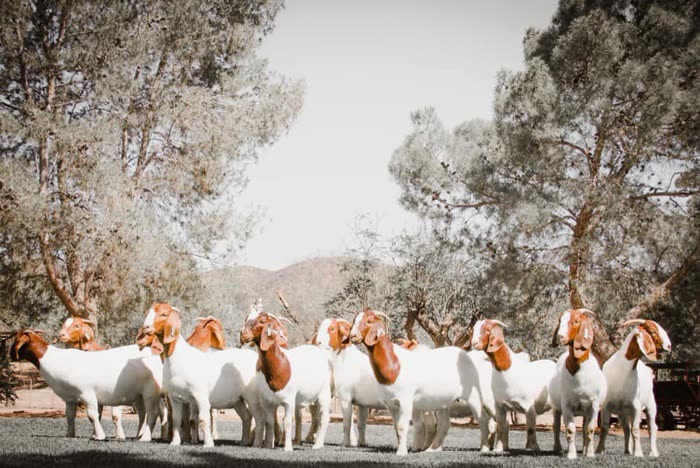
- Early 1900sFarmers in the Eastern Cape around Somerset East select lop-eared goats for meat, fertility and hardiness.
- 1920s to 1930sAn improved white-bodied, red-headed type becomes recognisable; animals compared at local shows.
- 4 July 1959Founding meeting of the breeders' association at Somerset East; sixteen attend and a committee drafts the standard.
- 16 October 1959Breed standard and constitution approved; T B Jordaan elected first chairman.
- 1960First national sale at Somerset East: 54 bucks offered, 22 sold, average R135.
- 1962First South African championships at Somerset East; Port Elizabeth in 1964.
- 1980s to 1990sExports to the United States, Australia, New Zealand, Canada and African countries; embryo exports begin.
- 2005Collaboration agreement between the Boer Goat, Kalahari Red and Savanna societies.
- 2018GBAZ re-founded in Zimbabwe after imported stud goats could not be registered locally.
- 2019First Goat Indaba; GBAZ drafts breed standards for the Boer Goat, Kalahari Red and Savanna.
- 2024First GBAZ goat auction at the Harare Showgrounds.
- 2025Eleven Zimbabwean breeders inspected by a South African society inspector; Boer Goat Society of Zimbabwe launched.
- 2026Boer Goat Society of Zimbabwe constituted as a GBAZ chapter; Boer classes judged at the Bulawayo Agricultural Show.
Sources
This book was written from the sources below. Figures are quoted with their origin; where sources disagree the range is given. The breed's origin is stated as history; the standard applied in Zimbabwe is the GBAZ standard administered by the Boer Goat Society of Zimbabwe, and registration is by the Zimbabwe Herd Book.
- Boer Goat Journal 2025, no. 31: history of the Boer Goat, breeding policy, breed standard, show and auction rules, society highlightsBoer Goat Breeders' Association journal (annual)
- Boer Goat breed standardsBoer Goat Breeders' Association
- Boer Goat origin (essay by Prof E Terblanche)Boer Goat Breeders' Association
- Small ruminant production and the small ruminant genetic resource in tropical Africa: Boer goat breed description (Wilson, 1991, Animal Production and Health Paper 88)FAO
- Boer goatWikipedia (citing Casey and Van Niekerk 1988, Erasmus 2000, DAD-IS)
- ABGA breed standards and disqualificationsAmerican Boer Goat Association
- Growth performance of Boer goat kids at Neudamm (birth weight, weaning weight, pre-weaning gain)University of Namibia digital repository
- Zimbabwe's goat industry evolves with new standards (9 February 2026)Farmer's Weekly
- Eland Zakithi Stud dominates Bulawayo Agricultural Show 2026 sheep and goats competition (24 April 2026)Sunday News
- Goat Indaba to spotlight climate-smart breeding (28 October 2026)The Chronicle
- ZimTrade launches model to propel goat meat exports (31 October 2025)The Herald
- Goat Indaba 2019 on next week (12 September 2019)The Herald
- Small livestock production on the rise (22 May 2026): national goat populationManica Post
Register your Boer Goat animals
GBAZ sets the breed standard and inspects animals. Stud breeder members register inspected animals with the Zimbabwe Herd Book, the statutory registrar, which issues the registration certificate.
Boer Goat photographs
Open the photo gallery