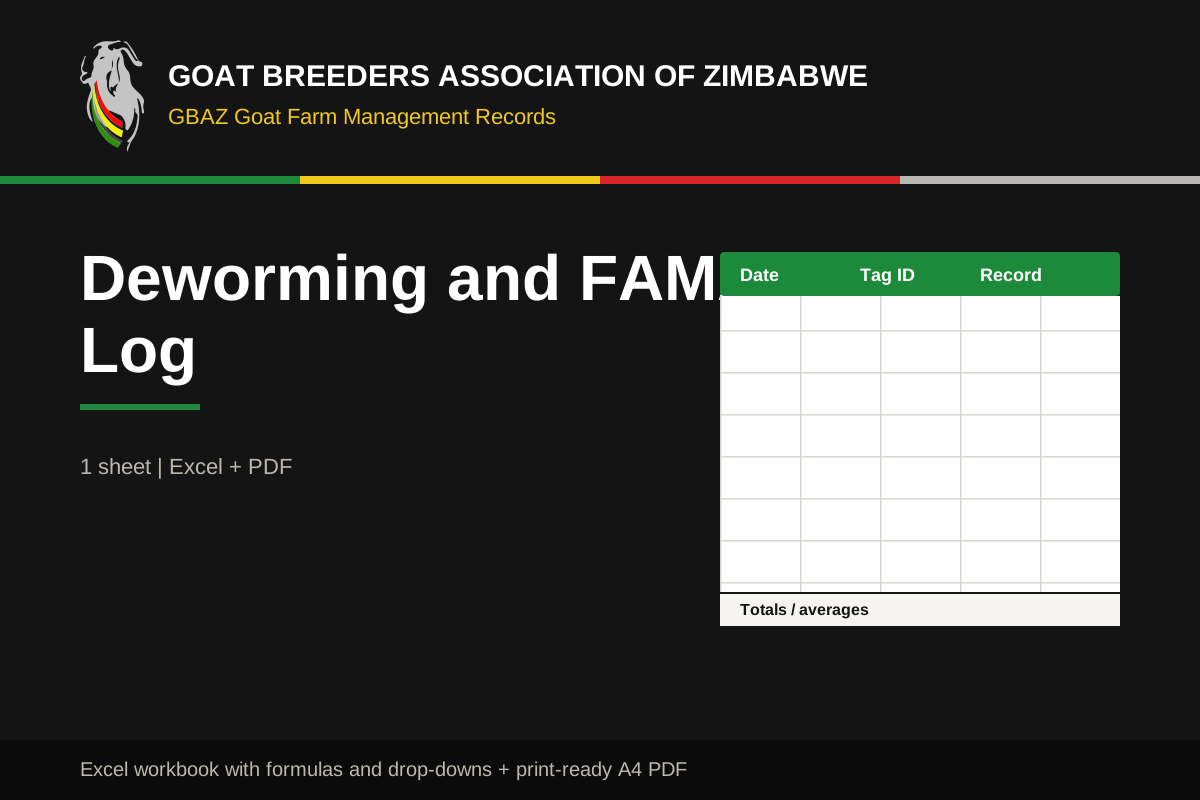
Deworming and FAMACHA Log
Targeted selective treatment made simple: score each goat's eyelid colour (FAMACHA 1 to 5) and body condition and record who was dosed with what. The sheet calculates withdrawal end dates, the share of the flock needing treatment and the next check date.
2 files to download
- XLSXExcel workbook (.xlsx)
- PDFPrint-ready PDF (A4)
Downloads unlock on your private order page as soon as payment is confirmed, and a link is emailed to you.
Targeted selective treatment made simple: score each goat's eyelid colour (FAMACHA 1 to 5) and body condition and record who was dosed with what. The sheet calculates withdrawal end dates, the share of the flock needing treatment and the next check date.
What is included
- Excel workbook (.xlsx) with one data sheet (FAMACHA Log), an Instructions sheet and a Lists sheet that feeds the drop-downs. Opens in Excel 2010 or later, LibreOffice and Google Sheets.
- Print-ready A4 PDF (landscape) with GBAZ branding, ruled rows, an instructions panel and a notes box on every page.
- Farm details block, yellow input cells, drop-down lists, data validation, frozen headers, filters and print titles on every sheet.
FAMACHA Log
Check every goat with the FAMACHA card in good daylight and record the score (1 red, 5 white). Add body condition (1 thin to 5 fat) and whether the goat is scouring or has bottle jaw. The Treat? column flags score 4 or 5, scouring, or body condition 2 or below. Dose by weight (goats need about 1.5 to 2 times the sheep dose of most drenches), note the product, its group and withdrawal, and the sheet sets the next check at 14 days for scores of 3 and above or 28 days otherwise.
Columns: Date checked, Tag ID, Class, FAMACHA score (1-5), Body condition (1-5), Scouring / bottle jaw?, Weight (kg), Dewormed?, Product, Dewormer group, Dose (ml), Withdrawal (days), Notes. Calculated: Treat?, Withdrawal ends, Days since check, Next check.
Summary cells: Goats checked; Average FAMACHA; Score 4 or 5 (anaemic); % flagged for treatment; Goats dewormed; Average body condition.
Formulas
Treat? flags FAMACHA 4 or 5, scouring, or body condition 2 or less with nested IF; withdrawal end = date + withdrawal days; days since check = TODAY() - date; next check = date + 14 for scores of 3 and above, otherwise + 28. Averages and counts use AVERAGE, COUNTIF and COUNTA.
Benchmarks and good practice
- FAMACHA scores anaemia caused by the barber's pole worm (Haemonchus), the main worm of goats in Zimbabwe's wet season. Use an original colour card; photocopies are not accurate.
- Drench only the goats that need it (targeted selective treatment) to slow dewormer resistance. Kids, late-pregnant and lactating does need treatment at score 3.
- Rotate between dewormer groups by year rather than at every dose, and check that a drench still works by re-scoring or faecal egg count 10 to 14 days later.
- Cull goats that need dosing at every check: about 20 percent of animals carry 80 percent of the worms.
Layouts follow the record books recommended by extension services (FAO, ILRI, Heifer International Zimbabwe, Cornell Small Farms, Uganda MAAIF and WormBoss guidance), adapted for Zimbabwean goat breeders by GBAZ.
Goat Breeders Association of Zimbabwe
Sold on the GBAZ platform on behalf of Goat Breeders Association of Zimbabwe, who delivers the product.